
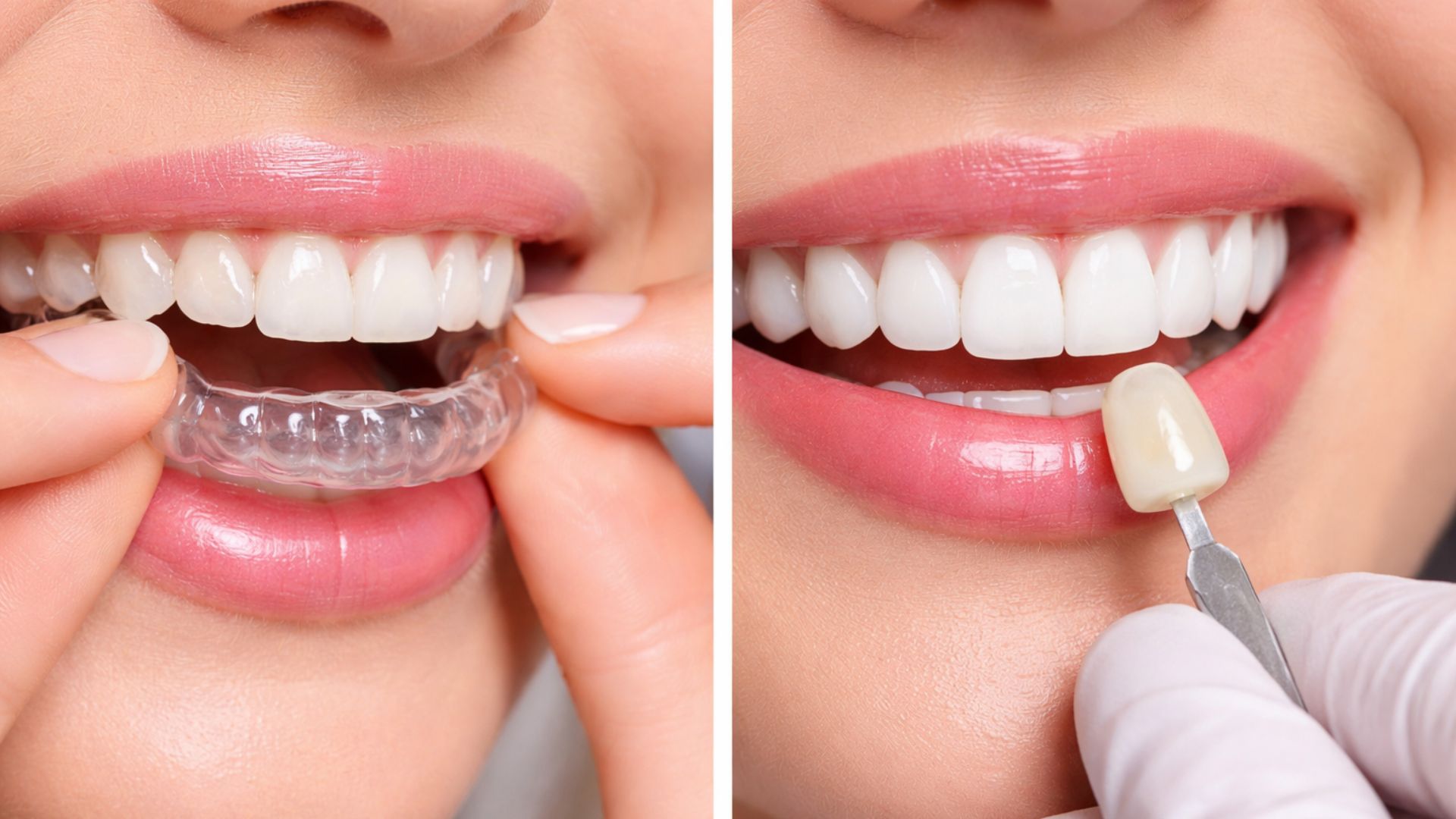
Choosing between Invisalign and veneers comes down to one core question: are you trying to fix how your teeth are positioned, or how they look? These two treatments solve different problems, even though they often get grouped together as “smile makeover” options. If you’re comparing Invisalign vs veneers, you’re likely dealing with crowding, gaps, or discoloration and want a straight answer on which path gets you there faster and with fewer regrets. This guide breaks down what each treatment actually does, how long results last, what you’ll pay in Toronto, and how to decide which one matches your specific smile goals.
Invisalign vs Veneers: The Core Difference You Need to Understand First
Invisalign moves your existing teeth into a new position using a series of clear aligners. Veneers do not move anything. They are thin shells bonded to the front surface of your teeth to change their shape, size, or color.
This distinction matters more than most comparison articles admit. If your teeth are crooked, veneers can visually mask minor misalignment, but they cannot correct a bite problem or significant crowding. Invisalign actually repositions the teeth, which means the change is structural, not cosmetic.
People with mild to moderate spacing issues, rotated teeth, or an uneven bite typically need orthodontic movement first. Those with well-aligned teeth that are simply discolored, chipped, or unevenly shaped are usually better candidates for veneers alone.
Some patients need both. A short round of Invisalign to align the teeth, followed by veneers or bonding to refine the final appearance, is a common sequence for people chasing a complete smile makeover.
Understanding this distinction sets up every other decision in this comparison, starting with how each treatment actually works.
How Invisalign Works and Who It’s Really For
Invisalign uses a series of custom-made clear plastic aligners, typically replaced every one to two weeks, that gradually shift teeth into their correct position. Each aligner applies gentle, targeted pressure to specific teeth.
Treatment time ranges widely depending on complexity. Minor crowding cases can wrap up in four to six months, while more involved cases involving bite correction can take twelve to twenty-four months.
Invisalign works well for:
- Mild to moderate crowding
- Gaps between teeth
- Minor bite misalignment (overbite, underbite, crossbite)
- Teeth that have shifted after previous orthodontic treatment
It is removable, which means you take the aligners out to eat, drink, and brush. This is a genuine advantage over traditional braces, but it also means results depend heavily on discipline. Aligners need to be worn 20 to 22 hours a day to stay on schedule.
If you’re unsure whether your case qualifies, a consultation focused on check-up and preventive dentistry is the right starting point, since a full oral exam determines whether alignment or cosmetic treatment should come first.
Once your teeth are properly positioned, or if they already are, veneers become the more relevant option for shaping the final look.
How Veneers Work and What They Actually Fix
Porcelain veneers are thin custom shells, usually made from porcelain or composite resin, bonded to the front of your teeth. They are built to correct:
- Permanent discoloration that doesn’t respond to whitening
- Chipped or worn tooth edges
- Small gaps or minor unevenness in tooth shape
- Teeth that are naturally too small or irregularly shaped
The process typically requires two to three visits. Your dentist removes a thin layer of enamel, takes an impression, and fits a custom shell matched to your desired shade and shape. Same-day options exist in some practices using digital scanning technology.
Veneers do not fix crowding or bite issues. Placing a veneer over a rotated or overlapping tooth often looks unnatural and can create longer-term issues with gum health and cleaning access.
This is where many patients get frustrated after choosing veneers without first addressing alignment. If your dentist recommends preparatory orthodontic work, it typically saves you from redoing veneers within a few years. For patients weighing veneers against a more conservative option, comparing veneers vs bonding is worth doing before committing to either.
Next, let’s look at what actually determines how long each treatment lasts, since durability is often the deciding factor for patients on a budget.
Longevity: Which Investment Holds Up Longer
Invisalign results are permanent in the sense that once teeth move, they stay in their new position, provided you wear a retainer as instructed afterward. Skipping retainer wear is the most common reason people see their teeth shift back over time.
Veneers have a defined lifespan. Porcelain veneers typically last between 10 and 15 years with proper care, while composite veneers usually need replacement every 5 to 7 years. For a full breakdown of what affects this range, see how long do veneers last.
Several factors shorten veneer lifespan:
- Grinding or clenching (bruxism)
- Biting into hard foods like ice or hard candy
- Poor oral hygiene leading to decay at the veneer margin
- Physical trauma to the mouth
If you grind your teeth at night, a night guard is often recommended alongside veneers to protect the investment. Skipping this step is one of the most common reasons veneers fail early.
Cost is closely tied to longevity, and it’s the next factor most patients ask about directly.
Cost Comparison: Invisalign and Veneers in Toronto
Pricing varies by case complexity, provider, and how many teeth are involved, but here’s a general range based on current Toronto market rates.
Invisalign in Toronto typically runs between $3,500 and $8,000 for a full course of treatment, depending on case complexity. Minor “express” cases addressing only front teeth crowding can cost less.
Veneers are typically priced per tooth. Porcelain veneers generally range from $900 to $2,500 per tooth, while composite veneers cost less, often between $300 and $800 per tooth. A full smile makeover involving 6 to 8 veneers can therefore range significantly, and reviewing porcelain veneers cost in Toronto gives a clearer per-case estimate.
Neither Invisalign nor veneers are typically covered under standard dental insurance, since both are considered cosmetic or elective in most policy definitions. It’s worth checking your specific plan, and reviewing your options under the Canadian Dental Care Plan if you qualify, since coverage rules vary by treatment classification.
Cost matters, but so does how each treatment affects your daily life during treatment, which is where the real day-to-day differences show up.
Daily Life During Treatment: What to Actually Expect
Invisalign requires ongoing commitment. You remove aligners for meals, which means no snacking without a full brush-and-reinsert routine. Speech can feel slightly different for the first few days of each new aligner, though most patients adjust quickly.
Veneers involve almost no lifestyle disruption after the initial placement. There’s a short adjustment period for bite sensation, but eating, speaking, and daily hygiene return to normal almost immediately.
For patients with demanding social or professional schedules, this difference often tips the decision. Invisalign demands weeks or months of behavioral consistency. Veneers demand a shorter, more intensive procedural commitment upfront, then very little ongoing effort.
Neither option is inherently harder, but they suit different personality types and daily routines. This leads naturally into the question of who should choose which treatment based on their actual goals.
Which One Fits Your Smile Goals: A Practical Framework
Choose Invisalign if:
- Your teeth are visibly crooked, gapped, or crowded
- You have a mild to moderate bite misalignment
- You want a non-surgical, reversible-during-treatment option
- You’re comfortable with months of consistent aligner wear
Choose veneers if:
- Your teeth are already well-aligned
- You’re dealing with discoloration that whitening can’t fix
- You have minor chips, wear, or shape irregularities
- You want faster, more dramatic cosmetic results
Choose both, sequentially, if:
- You have both alignment and cosmetic concerns
- You want the most durable, natural-looking final result
- You’re planning a comprehensive smile makeover
A consultation with a dentist who evaluates both your bite and your cosmetic goals is the only reliable way to know which category you fall into. Guessing based on online comparisons alone often leads to spending money on the wrong treatment first.
With the decision framework clear, it helps to look at a few common scenarios patients bring into consultations, since real cases often clarify the choice faster than general rules.
Real-World Scenarios That Clarify the Decision
Scenario one: A patient has straight teeth but years of coffee staining that professional whitening no longer fully resolves. This is a textbook veneer case. Alignment isn’t the issue, so Invisalign would add cost and time without addressing the actual concern.
Scenario two: A patient has noticeable crowding on the lower front teeth along with mild discoloration. Jumping straight to veneers here risks an unnatural result, since veneers placed over crowded teeth rarely look symmetrical. Invisalign first, then whitening or minor bonding, is the more predictable path.
Scenario three: A patient wants a complete transformation before a major life event and has both spacing gaps and uneven tooth shape. This is where sequential treatment, Invisalign followed by veneers, produces the most durable and natural-looking outcome, even though it takes longer.
These scenarios show why a proper diagnostic exam matters more than choosing a treatment based on marketing or social media trends. The right sequence protects both your smile and your budget.
Before finalizing either treatment, it’s also worth understanding the maintenance commitment each one carries long term.
Long-Term Maintenance: What Happens After Treatment Ends
After Invisalign, retainers are non-negotiable. Most dentists recommend full-time wear for the first few months, tapering to nightly wear indefinitely. Skipping this step is the single biggest cause of relapse.
After veneers, maintenance is closer to standard dental care, with a few added precautions. Avoid biting directly into very hard foods, wear a night guard if you grind your teeth, and keep up with regular dental cleanings to prevent decay at the veneer edges.
Both treatments benefit from routine professional monitoring. A veneer with a hairline crack or a retainer that no longer fits properly are both problems that get worse, not better, if ignored.
Long-term success with either option depends less on the initial procedure and more on how consistently you follow through afterward.
Making the Final Decision With Confidence
Invisalign and veneers solve different problems, and understanding that distinction is the real key to choosing correctly. If your concern is position, alignment, or bite, Invisalign addresses the root cause. If your concern is color, shape, or minor wear on teeth that are already well-positioned, veneers deliver faster cosmetic results.
The best next step is a professional evaluation that looks at both your alignment and your cosmetic goals together, rather than choosing one treatment in isolation. A clear diagnostic plan now saves you from costly corrections later and gets you to the smile you actually want, on a timeline that makes sense for your life.
FAQ
Can I get veneers if I have slightly crooked teeth?
Minor irregularities can sometimes be masked with veneers, but visible crowding or rotation usually requires alignment first. A dentist can assess whether your case is mild enough for veneers alone.
Is Invisalign painful compared to veneers?
Invisalign causes mild pressure discomfort with each new aligner, lasting a few days. Veneer placement involves minor enamel removal, with brief sensitivity afterward that typically resolves within a week.
Do I need a retainer forever after Invisalign?
Most dentists recommend nightly retainer wear indefinitely to prevent relapse. Teeth can shift throughout life even without orthodontic history, so retention is an ongoing commitment.
Can veneers be whitened later if they stain?
Porcelain veneers resist staining well and generally don’t respond to whitening treatments, so shade is chosen at placement. Composite veneers can pick up some stain over time and may need polishing or replacement.
Which treatment is better for a wedding or big event?
Veneers typically deliver faster visible results, making them suitable for shorter timelines. Invisalign requires months of treatment, so it needs to start well in advance of any event date.
Do I need x-rays before starting either treatment?
Yes. Both treatments require an evaluation of tooth and root health beforehand, often including digital x-rays, to rule out decay, bone loss, or issues that need addressing first.
Ready to Find Out Which Option Fits Your Smile?
The only way to know for certain whether Invisalign, veneers, or a combination of both is right for you is a proper in-person evaluation. Book a consultation with Heritage Dental Studio to get a personalized treatment plan based on your actual bite, tooth condition, and smile goals, not guesswork.


