If your dentist just told you that you need a filling, you have probably wondered which material makes more sense for your tooth. Composite vs amalgam fillings is one of the most common questions patients bring into a Toronto dental chair, and the right answer depends on where the cavity sits, how you chew, and what you want your smile to look like.
At Heritage Dental Studio, we place both materials regularly, and neither one is universally “better.” Each has strengths worth understanding before you commit.
This guide walks through how each filling type is made, how long they typically last, what they cost, and how to decide which one fits your mouth and your budget.
What Are Amalgam Fillings Made Of?
Amalgam is the classic “silver filling” that many adults grew up with. It is a metal alloy made primarily of mercury combined with silver, tin, and copper.
Dentists have used this material for more than 150 years because it is strong, inexpensive, and tolerant of moisture during placement. That durability made it the default choice for back teeth for generations.
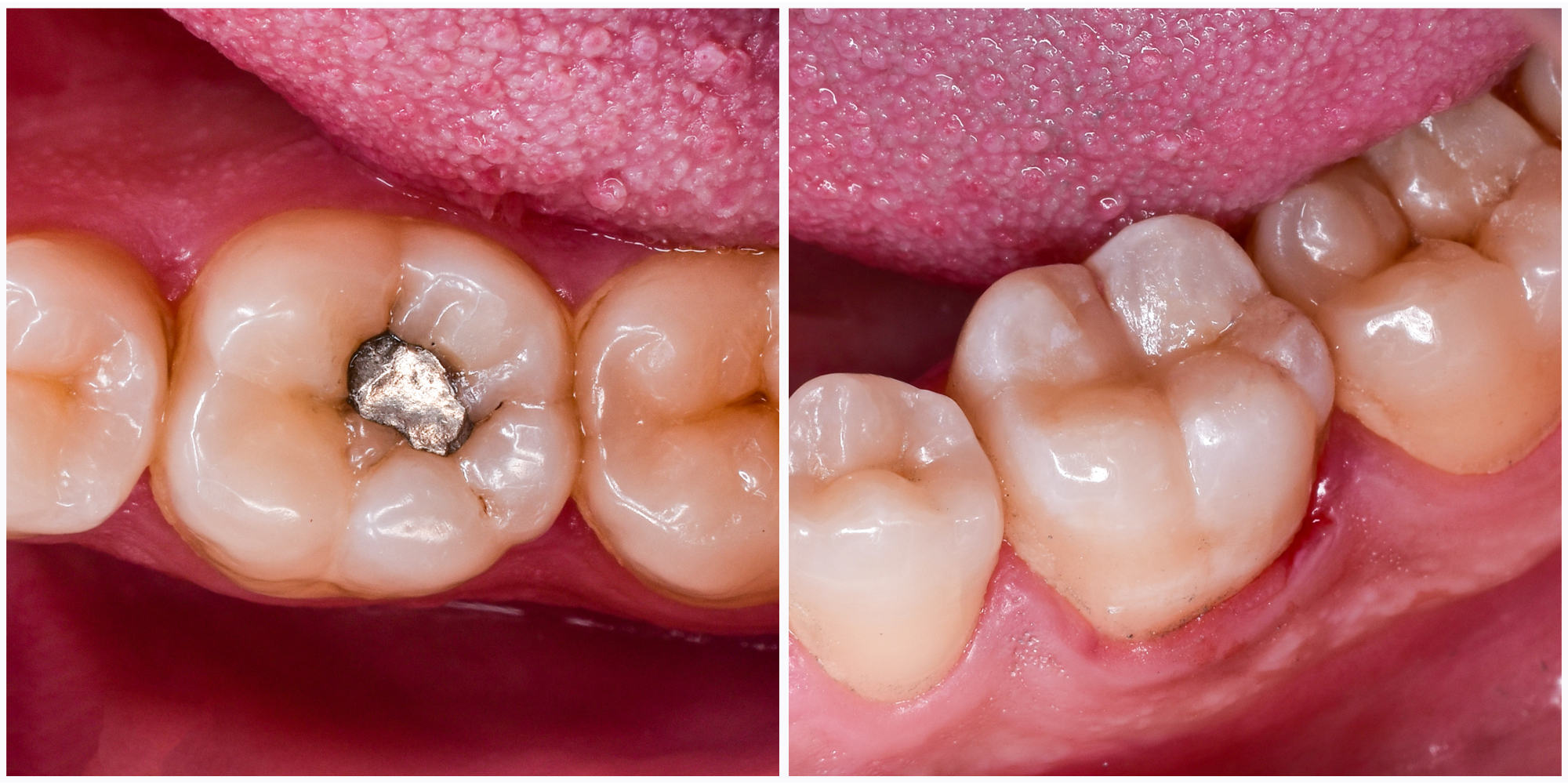
The tradeoff is aesthetics. Amalgam fillings are dark gray or silver, and they stand out clearly against natural tooth enamel, which is why fewer patients request them for visible teeth today.
Understanding what the material is made of sets up the next question most patients ask: how does composite resin compare?
What Are Composite Fillings Made Of?
Composite fillings are made from a tooth-colored resin, a blend of plastic and fine glass or ceramic particles. The dentist layers the material into the prepared cavity and hardens each layer with a curing light.
Because the shade can be matched to your natural enamel, composite fillings blend in rather than stand out. This makes them the preferred option for front teeth and any tooth visible when you smile or talk.
Composite also bonds directly to the tooth structure, which means less healthy enamel typically needs to be removed compared to amalgam preparation. That bonding process is part of why composite has become the more commonly requested option, as detailed in our comparison of tooth-colored fillings as a service.
With the basic composition covered, the next logical comparison is strength and how each material holds up over years of chewing.
Durability: Which Filling Lasts Longer?
Amalgam has a well-earned reputation for withstanding heavy chewing forces, particularly on molars where bite pressure is highest. Many amalgam fillings remain functional for well over a decade with routine care.
Composite fillings have improved substantially in strength over the past two decades, though they can still be more prone to wear or chipping in high-pressure areas like the back molars compared to amalgam.
For most small to mid-sized cavities, the practical lifespan difference between the two materials has narrowed considerably as composite formulations have advanced. Our detailed breakdown of how long fillings typically last covers the variables that influence longevity for both types.
Location in the mouth matters just as much as material choice, which brings us to how dentists actually decide between the two.
How Location in the Mouth Affects the Decision
Front Teeth
For incisors and canines, composite is typically the clear choice. The tooth-colored finish blends naturally, and front teeth generally experience less crushing force than molars.
Back Teeth (Molars and Premolars)
Molars absorb the brunt of chewing force, which is where the durability conversation gets more nuanced. Some dentists still favor amalgam for very large cavities on molars in patients with heavy grinding habits, while composite remains suitable for small to moderate cavities in the same location.
Between Teeth
Cavities on the surfaces between teeth can be trickier to fill precisely with composite because moisture control is more difficult in that area, though skilled placement generally overcomes this.
Once you understand where the cavity sits, cost becomes the next major factor shaping the decision.
Cost Comparison: Composite vs Amalgam
Amalgam fillings are generally the less expensive option because the material itself costs less and placement tends to be quicker.
Composite fillings usually cost more, reflecting the additional preparation time, the layering and curing process, and the cosmetic shade-matching work involved.
The exact fee for either filling depends on the number of surfaces treated and the size of the cavity, which your dentist will outline before treatment begins. If you are budgeting around insurance, our guide to understanding the ODA fee guide explains how Ontario dental fees are typically structured.
For patients enrolled in the Canadian Dental Care Plan, coverage extends to composite and amalgam fillings alike as part of basic restorative care, though your specific co-payment depends on your income bracket, as outlined by the Government of Canada. You can review our page on what the CDCP covers for a fuller breakdown.
Patients under a certain adjusted family net income threshold typically pay nothing out of pocket for a basic filling under the plan, while higher income brackets share a percentage of the fee, which your dental office can calculate for you before treatment starts.
Cost is rarely the only consideration for patients, though. Safety questions come up just as often, especially around amalgam’s mercury content.
Is Amalgam Safe? Addressing the Mercury Question
Amalgam fillings do contain mercury, which understandably raises questions for many patients. Health Canada and major dental associations have reviewed the evidence extensively and continue to classify amalgam as safe for most adults and children over six.
Health Canada has specifically recommended avoiding amalgam placement in pregnant patients and young children when suitable alternatives exist, out of an abundance of caution rather than confirmed harm.
If you already have amalgam fillings that are intact and not causing sensitivity or decay underneath, dental organizations typically advise leaving them in place rather than replacing them purely out of concern. Removal itself creates temporary mercury vapor exposure that outweighs the benefit of swapping a healthy filling.
With safety questions addressed, let’s look at how each material performs during the actual appointment and afterward.
What to Expect During Placement
Getting an Amalgam Filling
Amalgam placement is typically faster because the material does not require light-curing in layers. Your dentist removes the decay, shapes the cavity, and packs the amalgam directly into place.
One consideration is that amalgam needs a slightly larger cavity preparation to mechanically hold the filling in place, since it does not bond to the tooth the way composite does.
Getting a Composite Filling
Composite placement takes more chair time because your dentist builds the filling in thin layers, curing each one before adding the next. This layered approach allows for a more conservative preparation that preserves more of your natural tooth.
Because composite bonds directly to enamel and dentin, the tooth can end up structurally stronger after the repair compared to a tooth restored with a non-bonded material.
Once the filling is placed, sensitivity is one of the most common short-term concerns patients report, regardless of material.
Sensitivity After a Filling
Some temporary sensitivity to hot, cold, or pressure is normal after either type of filling while the tooth’s nerve settles down.
Composite fillings can occasionally cause a brief period of heightened sensitivity related to the bonding and curing process, while amalgam sensitivity is more often linked to temperature conductivity through the metal.
If sensitivity persists beyond a few weeks or intensifies rather than improves, it is worth having the tooth checked. Our article on sensitivity after a filling walks through when to be concerned and when it typically resolves on its own.
Beyond sensitivity, appearance is often the deciding factor for patients weighing these two options.
Aesthetics: Why Appearance Matters to Many Patients
For a molar that never shows when you smile, appearance may not weigh heavily in your decision. For a premolar or any tooth visible in conversation or photos, the difference becomes obvious.
Composite fillings are custom-shaded to match surrounding enamel, so a well-placed one is very difficult to spot even up close.
Amalgam fillings darken with age and are visible as a silver or gray patch, which is why most patients today choose composite for any tooth within the visible smile zone.
Appearance ties closely into a related consideration: what happens to the surrounding tooth structure over time.
Long-Term Tooth Structure Considerations
Because amalgam does not bond to the tooth, the cavity preparation must be shaped in a way that mechanically locks the filling in place. This can require removing slightly more healthy tooth structure than a composite preparation would.
Composite’s bonding capability allows for more conservative, tooth-preserving preparations, which some dentists consider a meaningful long-term advantage, particularly in younger patients who may need the filling to last for decades.
That said, amalgam’s resistance to wear under heavy occlusal load remains a genuine advantage in specific clinical situations, which is why a one-size-fits-all recommendation does not serve every patient well.
Given all these variables, here is how to think through the decision practically.
How to Decide: A Practical Framework
Start by considering where the cavity is located. Front teeth generally point toward composite, while very large molar cavities in patients with significant grinding habits sometimes still favor amalgam.
Next, factor in your budget and insurance coverage. If cost is the primary concern and the tooth is not visible, amalgam remains a reasonable, well-tested option.
Finally, talk with your dentist about your bite, your history of cavities, and any habits like teeth grinding that could influence which material will hold up best for your specific mouth. If grinding is a factor, it is worth reading about teeth grinding and bruxism alongside your filling decision.
There is no universally correct answer, only the option that fits your specific tooth, habits, and priorities.
Caring for Your Filling After Placement
Regardless of which material you choose, the daily habits that protect a filling are the same. Brush twice daily, floss around the filled tooth, and avoid using your teeth to open packaging or crack hard foods.
Routine dental visits allow your dentist to check the margins of the filling for any signs of leakage or new decay starting underneath. Our guide on how often you should get a teeth cleaning explains the typical recall schedule that supports this kind of early detection.
Good home care and consistent checkups do more to extend the life of any filling than the material itself.
The History Behind Why Amalgam Became Standard
Amalgam earned its place in dentistry because it solved a real problem: dentists needed a material that could be packed into a wet, awkward space in the mouth and still harden into something strong enough to survive a lifetime of chewing.
Before reliable bonding agents existed, that moisture tolerance made amalgam almost irreplaceable for back teeth. It did not require a perfectly dry field, and it did not demand the precise layering technique that resin composites need today.
Generations of dentists trained on amalgam because it was predictable, forgiving during placement, and inexpensive to produce at scale. That legacy is part of why so many adults still have amalgam fillings from childhood sitting quietly in their molars.
Composite resin existed in earlier forms decades ago, but it lacked the strength and wear resistance needed for reliable use on chewing surfaces. It was mostly reserved for front teeth where bite force was lower.
Understanding that history helps explain why your parents or grandparents likely have a mouth full of silver fillings while composite has become the default recommendation for most new cavities today.
How Materials Science Changed the Conversation
The shift toward composite accelerated as manufacturers improved the resin’s filler particles, the microscopic glass or ceramic components that give the material its strength.
Early composites used larger filler particles that wore down relatively quickly under chewing force. Modern nanohybrid and nanofilled composites use much smaller, more evenly distributed particles, which improves both strength and polish retention.
Bonding agents also advanced considerably. Today’s adhesive systems create a much more reliable seal between the composite and the tooth structure than the bonding agents available even fifteen years ago.
These improvements are a major reason composite has closed much of the durability gap with amalgam for small and medium-sized cavities, particularly outside of heavy grinding cases.
This technological progress explains why many dental practices, including ours, now place composite as the default recommendation for the majority of new cavities, reserving amalgam for specific situations where its properties are still genuinely advantageous.
A Closer Look at Placement Technique Differences
Isolation and Moisture Control
Composite bonding requires a dry, well-isolated field during placement. Saliva or blood contamination during the bonding step can weaken the bond and shorten the filling’s lifespan.
This is why your dentist may use a rubber dam, cotton rolls, or suction more aggressively during a composite filling than during an amalgam placement, where moisture tolerance is less critical.
Layering Technique
Composite is placed in increments, typically one to two millimeters at a time, with each layer cured under a bright blue light before the next is added. This incremental approach reduces shrinkage stress that could otherwise create microscopic gaps.
Amalgam, by contrast, is condensed into the cavity in a single continuous process and does not require curing, since it hardens through a chemical reaction over the following hours.
Finishing and Polishing
Composite fillings are shaped and polished immediately after placement to blend seamlessly with the surrounding tooth contour. Amalgam is carved to shape while still soft, then polished at a follow-up visit once it has fully hardened, which sometimes means a short waiting period before final smoothing.
These technical differences are worth understanding because they explain part of why composite fillings typically involve a longer chair-side appointment.
Environmental and Disposal Considerations
Amalgam contains mercury, which means dental offices are required to follow specific waste management protocols when removing or placing amalgam restorations to prevent the metal from entering wastewater systems.
Modern dental clinics use amalgam separators, devices designed to capture mercury particles before they reach the drain, as part of standard environmental compliance.
Composite materials do not carry the same mercury handling requirements, though the resin and any associated packaging still follow standard clinical waste protocols.
For patients who weigh environmental factors alongside personal health considerations, this is sometimes part of the broader decision-making conversation, even though it is rarely the deciding factor on its own.
Special Considerations for Specific Patient Groups
Patients With Metal Allergies
A small number of patients report sensitivity to metals found in amalgam. If you have a documented metal allergy, composite is typically the more comfortable choice, and your dentist can discuss alternatives during your consultation.
Patients With Bruxism or Heavy Grinding
If you grind or clench your teeth, either during the day or at night, this is one of the clearest situations where amalgam’s wear resistance can offer a genuine practical advantage on molars, though a properly fitted night guard often matters more than filling material alone. Reading about night guards for grinding is worth doing regardless of which filling material you choose.
Patients Prioritizing a Natural Appearance
If your priority is a completely invisible restoration, composite is almost always the recommended path, particularly for any tooth that shows when you speak or smile.
Patients on a Tight Budget
If cost is the primary driver and the tooth in question is a back molar that is not visible, amalgam remains a legitimate, cost-conscious option backed by decades of clinical performance data.
Every one of these situations is a reminder that the “right” filling material is genuinely personal, shaped by your mouth, your habits, and your priorities rather than a single universal answer.
Questions Worth Asking Your Dentist
Before you commit to either material, it can help to ask a few direct questions during your appointment. Ask how large the cavity is and whether that size changes which material is recommended.
Ask whether the tooth is under heavy bite load and whether that affects the expected lifespan of a composite filling in that specific location.
Ask what your insurance plan or CDCP coverage will pay for each option so you can compare the out-of-pocket cost clearly before deciding.
Finally, ask how experienced your dental team is with each material, since technique-sensitive composite placement benefits from a dentist who places it routinely.
What Happens If a Filling Fails
No filling lasts forever, and understanding the warning signs of failure helps you catch a problem before it becomes a bigger, more expensive repair.
Signs an Amalgam Filling May Need Replacement
Watch for cracks radiating out from the filling into the surrounding tooth, a change in bite feel, or new sensitivity that was not present before. Amalgam can also corrode slightly over time, which sometimes causes the surrounding tooth to darken.
Signs a Composite Filling May Need Replacement
Composite can wear down gradually, developing small chips at the edges or a rough texture that traps plaque more easily. Staining around the margins of a composite filling can also signal that the seal has weakened and decay may be forming underneath.
In both cases, catching the issue early through routine exams usually means a simple repair rather than a more involved procedure like a crown. This is one more reason consistent checkups matter as much as the material you originally chose. Our page on what happens during a dental checkup explains what your dentist is specifically looking for at each visit.
When a Filling Isn’t Enough Anymore
If decay has spread significantly beyond what a filling can repair, or if the tooth has cracked substantially, your dentist may recommend a crown instead. Our comparison of dental crown versus filling explains how that decision gets made when a filling alone will not restore the tooth adequately.
The Bigger Picture: Prevention Still Matters Most
Choosing the right filling material is important, but preventing the next cavity matters even more. Both composite and amalgam are repairs, not cures, for the underlying causes of tooth decay.
Consistent brushing, flossing, and a diet lower in frequent sugar exposure remain the most effective tools for avoiding future fillings altogether. Our guide on how to prevent cavities covers the daily habits that make the biggest difference.
Fluoride also plays a meaningful supporting role in strengthening enamel and resisting new decay, particularly for patients who have needed multiple fillings in the past. You can learn more in our overview of fluoride treatment for adults.
Whichever material you and your dentist choose for your current cavity, pairing that decision with strong preventive habits is what actually protects your smile over the long run.
Frequently Asked Questions
Can I switch from amalgam to composite fillings?
Yes, existing amalgam fillings can be replaced with composite when they need to be redone due to wear or decay. Dental organizations generally do not recommend replacing intact, healthy amalgam fillings solely for cosmetic reasons.
Does insurance cover composite fillings the same as amalgam?
Many Ontario insurance plans and the CDCP cover composite and amalgam similarly for back teeth, though some older plans reimburse composite on molars at the amalgam rate, with the patient covering the difference.
How long does a composite filling take to place?
A single-surface composite filling typically takes 20 to 40 minutes, though multi-surface or larger fillings take longer due to the layering and curing process involved.
Which filling is better for a child’s tooth?
Composite is frequently preferred for children because Health Canada has advised caution around amalgam in young children, and composite blends with baby and permanent teeth alike.
Will my filling match the color of my other teeth?
Composite fillings are shade-matched to your surrounding enamel before placement, so they typically blend in closely, though very old fillings may need reshading if your natural teeth change color over time.
Bringing It All Together
Composite and amalgam are both proven, effective ways to repair a cavity, and neither one is the wrong choice when it is matched to the right situation. Amalgam offers proven strength and a lower price point, particularly for large cavities on back molars that never show.
Composite offers a natural appearance, a more conservative approach to your tooth structure, and a bonding process that has closed much of the durability gap that once separated the two materials.
The best way to decide is a conversation, not a guess. Bring your questions about cost, appearance, grinding habits, and coverage into your next appointment, and let your dentist match the material to your specific tooth rather than a one-size-fits-all default.
Your smile deserves a filling chosen with intention, not convenience alone, and that decision starts with an informed conversation between you and your dental team.
Ready to Talk Through Your Filling Options?
Every tooth is different, and the right filling material depends on details only an in-person exam can confirm. The team at Heritage Dental Studio in downtown Toronto is ready to walk you through your options, review your coverage, and help you choose the filling that fits your smile and your budget.